How to Read Coefficients of a Regression in Excel
Previous article: Excel 2013 Regression Analysis How To
Excel Regression Assay Output Explained
Watch the video explaining the output:
Can't run across the video? Click here.
In the previous article, I explained how to perform Excel regression analysis. After you've gone through the steps, Excel will spit out your results, which volition wait something like this:
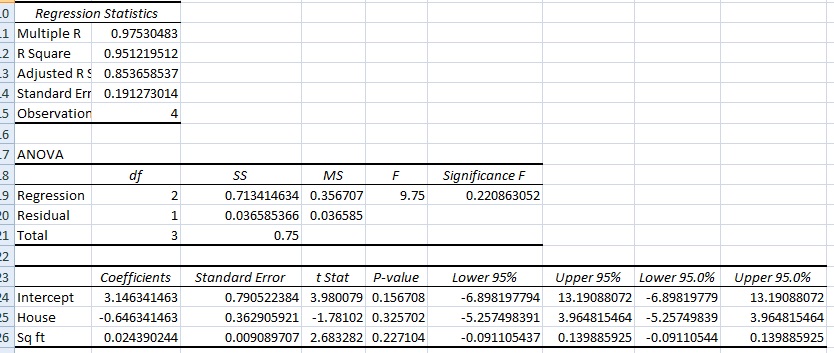
Excel Regression Assay Output Explained: Multiple Regression
Here's a breakup of what each slice of information in the output ways:
EXCEL REGRESSION Analysis OUTPUT PART 1: REGRESSION STATISTICS
These are the "Goodness of Fit" measures. They tell you how well the calculated linear regression equation fits your data.
- Multiple R. This is the correlation coefficient. It tells you how stiff the linear relationship is. For case, a value of 1 means a perfect positive relationship and a value of zero ways no relationship at all. Information technology is the square root of r squared (see #two).
- R squared. This is rii, the Coefficient of Determination. It tells yous how many points autumn on the regression line. for example, 80% means that 80% of the variation of y-values effectually the mean are explained by the x-values. In other words, 80% of the values fit the model.
- Adjusted R square. The adjusted R-square adjusts for the number of terms in a model. You lot'll want to utilise this instead of #two if you lot have more than 1 x variable.
- Standard Error of the regression: An guess of the standard deviation of the mistake μ. This is non the same as the standard error in descriptive statistics! The standard error of the regression is the precision that the regression coefficient is measured; if the coefficient is large compared to the standard mistake, then the coefficient is probably unlike from 0.
- Observations. Number of observations in the sample.
EXCEL REGRESSION Analysis OUTPUT EXPLAINED Part TWO: ANOVA
- SS = Sum of Squares.
- Regression MS = Regression SS / Regression degrees of liberty.
- Rest MS = mean squared error (Balance SS / Residual degrees of liberty).
- F: Overall F test for the cypher hypothesis.
- Significance F: The significance associated P-Value.
The 2d part of output you get in Excel is rarely used, compared to the regression output in a higher place. Information technology splits the sum of squares into individual components (run into: Rest sum of squares), so it tin be harder to utilise the statistics in any meaningful way. If you're just doing basic linear regression (and have no desire to delve into individual components) then you tin can skip this section of the output.
For instance, to calculate Rtwo from this table, you would use the following formula:
R2 = 1 – remainder sum of squares (SS Balance) / Total sum of squares (SS Total).
In the in a higher place table, residual sum of squares = 0.0366 and the full sum of squares is 0.75, so:
R2 = 1 – 0.0366/0.75=0.9817
EXCEL REGRESSION ANALYSIS Office 3: Translate REGRESSION COEFFICIENTS
This department of the table gives you lot very specific information about the components you lot chose to put into your data analysis. Therefore the first column (in this case, Firm / Square Anxiety) will say something different, co-ordinate to what data you put into the worksheet. For example, it might say "height", "income" or whatsoever variables you chose.
The columns are:
- Coefficient: Gives you the least squares estimate.
- Standard Error: the to the lowest degree squares approximate of the standard error.
- T Statistic: The T Statistic for the null hypothesis vs. the alternate hypothesis.
- P Value: Gives you the p-value for the hypothesis test.
- Lower 95%: The lower boundary for the confidence interval.
- Upper 95%: The upper boundary for the conviction interval.
The most useful office of this department is that it gives you the linear regression equation:
y = mx + b.
y = slope * 10 + intercept.
For the in a higher place tabular array, the equation would be approximately:
y = 3.fourteen – 0.65X1 + 0.024X2.
Have Care with Interpreting Certain Terms
Use caution when interpreting regression models that incorporate certain terms; It'southward impossible to look at simply the linear term (a master effect) and depict a decision. For example:
- A significant polynomial term can make the results difficult to clarify because irresolute a predictor variable varies, depending on the value of the predictor.
- A pregnant interaction term indicates the variation is due to the value of a different predictor.
References
Cameron. Excel Multiple Regression. http://cameron.econ.ucdavis.edu/excel/ex61multipleregression.html
Minitab. How to Interpret Regression Analysis Results: P-values and Coefficients.
Salkind, N. (2015). Excel Statistics: A Quick Guide Third Edition. SAGE Publications.
---------------------------------------------------------------------------
Need assist with a homework or test question? With Chegg Study, you can get step-by-step solutions to your questions from an adept in the field. Your first 30 minutes with a Chegg tutor is free!
Comments? Demand to post a correction? Please mail a comment on our Facebook page .
Source: https://www.statisticshowto.com/probability-and-statistics/excel-statistics/excel-regression-analysis-output-explained/
0 Response to "How to Read Coefficients of a Regression in Excel"
Post a Comment